Technical Articles
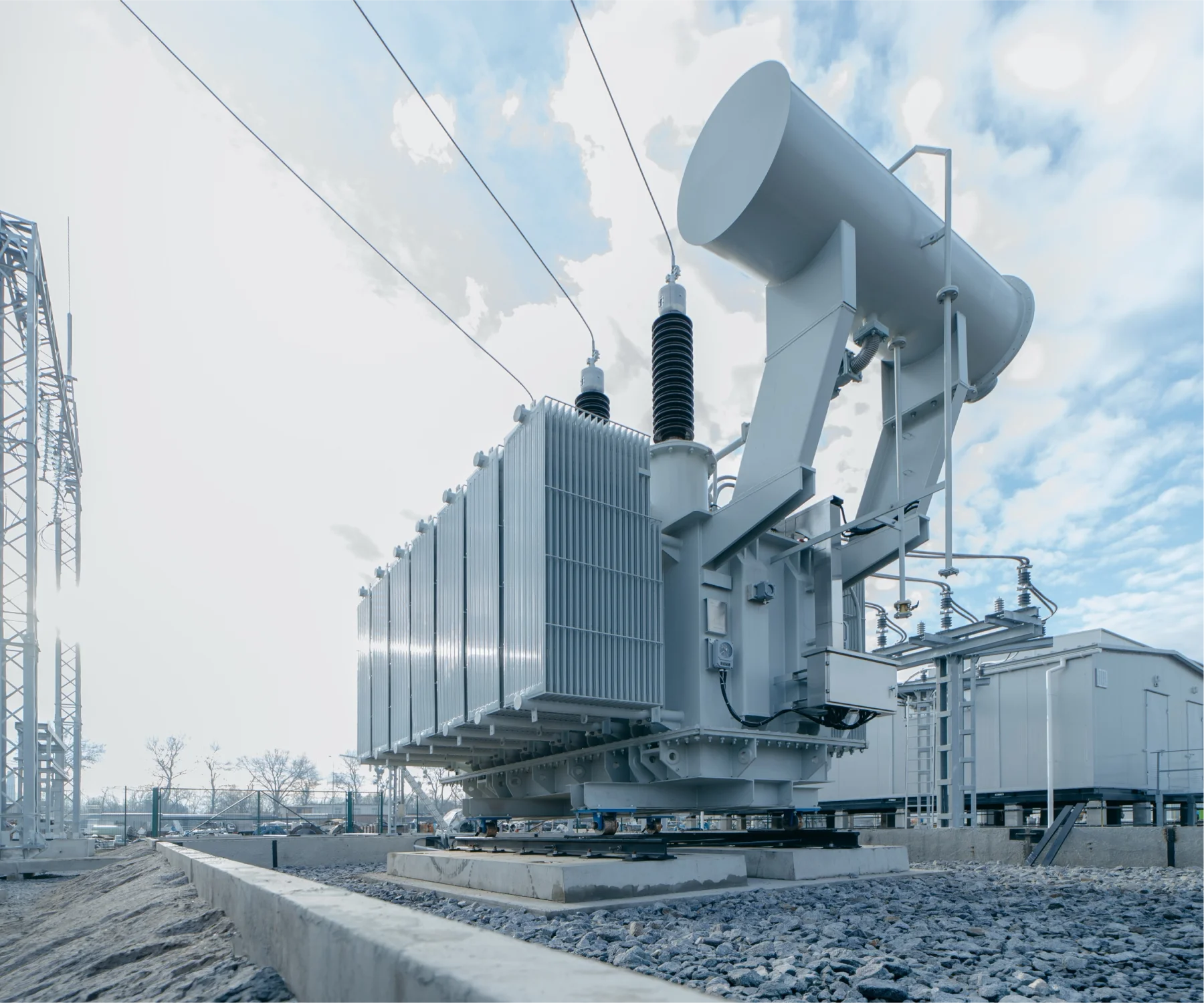
Harmonic currents are generated whenever non-linear loads are connected to the mains supply. The problems caused by harmonic currents include increased losses and overheating of transformers, over heating of cables, especially the neutral conductor, overheating and vibration in induction motors and premature failure of power factor correction capacitors. This article discusses the effects of harmonics specifically on transformers and a method to ensure the reliability of transformers in harmonics rich environments.
Losses in transformers are due to eddy current losses and stray magnetic losses in the core and resistive losses in the windings. Of these, eddy current losses play an important role in harmonic rich environments. These losses are directly proportional to the square of the frequency. Higher harmonic content would lead to higher eddy current losses. This in turn would increase the operating temperature of the transformer that could result in a premature failure.
In order to overcome the above ill effects, a special transformer called as k-factor transformer has been developed. This is a specifically de-rated transformer that is designed keeping in mind harmonic loads.
K-factor is defined as the ratio of total eddy current loss to the eddy current loss at the fundamental frequency.

Where, Pf is the eddy current loss at the fundamental frequency, f

Pf is the eddy current loss at hth harmonic Pt is the total eddy current loss
Ih is the hth harmonic current
Hence, if we know the harmonics spectrum, we can easily arrive at the amount of de-rating or the k-factor of the transformer.
K-Factor transformers available, are designed to take care of the increased stresses on account of Harmonics. Depending on the nature of the non linear load, suitable K-Factor transformers can be selected.
Where, Pf is the eddy current loss at the fundamental frequency, f
Pf is the eddy current loss at hth harmonic Pt is the total eddy current loss
Ih is the hth harmonic current
Hence, if we know the harmonics spectrum, we can easily arrive at the amount of de-rating or the k-factor of the transformer.
K-Factor transformers available, are designed to take care of the increased stresses on account of Harmonics. Depending on the nature of the non linear load, suitable K-Factor transformers can be selected.
Following are the typical K-Factor for non-linear loads connected:
| % non-linear load | K-Factor |
|---|---|
| <5% | K-1 |
| <35% | K-4 |
| <50% | K-7 |
| <75% | K-13 |
| <100% | K-20 |

Sourav Dasmodak,
Product Management & Marketing (Powergear - ACB)Product Owner of Air Circuit Breaker (ACB) of Lauritz Knudsen for Domestic & International Market. I can talk to you about Electrical Products' Sales, Business Development, Market Expansion, Cracking Critical Strategic Account, handling Key Account & of course how to develop & motivate Channels along with the organizational growth. Having near about one and a half decade of experience across the country with major electrical manufacturers (Top 4).

 Contact Us