Technical Articles
Choosing between an MCB, MCCB, RCCB, RCBO, and ACB is not about finding one "best" breaker. It is about pairing the right protection type to the right load. Circuit breaker selection depends on current rating, fault level, and whether earth leakage protection is needed as well. Knowing the difference between MCB vs MCCB, RCCB vs RCBO, MCB vs RCCB, and ACB vs MCCB vs MCB makes this easier. Each device has its own place in the distribution chain. Some sit at the main incomer, handling thousands of amps. Others sit at a single socket circuit, protecting a person from shock.
Walk into any panel room. Rows of breakers line the board, each doing a slightly different job. Some are large and adjustable, built for main incomers. Others are compact enough for a single socket circuit. Confusion around ACB vs MCCB vs RCCB vs RCBO, or where MCB fits in, usually comes from treating these devices as interchangeable. They are not. One handles massive fault currents at the main incomer. Another exists purely to protect a person from electric shock. Getting this wrong is not just inefficient. It can be genuinely dangerous.
Understanding these electrical protection devices is particularly important when designing low-voltage switchgear and circuit protection systems for residential, commercial, and industrial installations.
Every low-voltage circuit breaker exists to interrupt current when something goes wrong. But "wrong" covers different fault conditions. Overload, short circuit, and earth leakage are three separate faults. Not every breaker responds to all three. A breaker rated for one fault type may offer zero protection against another.
Current rating is not the only factor to consider when selecting a circuit breaker. The breaker must also be capable of safely interrupting the maximum prospective fault current available at its installation point. This breaking capacity is expressed in kA and becomes particularly important in commercial and industrial systems located close to transformers or other high-power sources.
Circuit breaker selection is not a paperwork exercise. It decides whether a fault stays contained or spreads through an installation. Selective coordination means only the breaker nearest the fault trips, leaving everything upstream unaffected.
Proper selective coordination is particularly important in larger circuit protection systems, where a fault should be isolated as close as possible to its source without unnecessarily disconnecting healthy parts of the installation.
Picture a workshop with an undersized breaker upstream of a motor load. Every start-up trips the breaker. Eventually, someone bypasses it out of frustration. This single decision removes the protection layer entirely. A wrongly sized breaker does not just cause nuisance tripping. It quietly erodes the safety margin of the whole panel, often unnoticed until a genuine fault occurs.
In a properly coordinated system, a fault on a lighting circuit trips only that circuit's breaker. The floor distribution board stays live. The main incomer feels nothing. This layered response depends on breakers being sized and time-graded correctly against one another. Without it, a small fault far from the main board can trip the entire incomer, plunging a whole floor into darkness for no good reason.
An MCB is the smallest and most familiar breaker on the list, found on almost every residential and small commercial panel. Its primary role is overload and short-circuit protection on final circuits. MCBs are commonly available from 6A to 125A, with residential installations typically using ratings up to 63A. The trip mechanism is thermal-magnetic, meaning thermal elements respond to slow, sustained overloads while magnetic elements respond to sudden short circuits.
MCBs are cheap, compact, and reset with a simple flip of the switch. What they lack is any sensitivity to earth leakage, which is the reason MCB vs RCCB keeps coming up in wiring discussions, and why MCB vs RCBO matters wherever one circuit needs both kinds of protection at once.
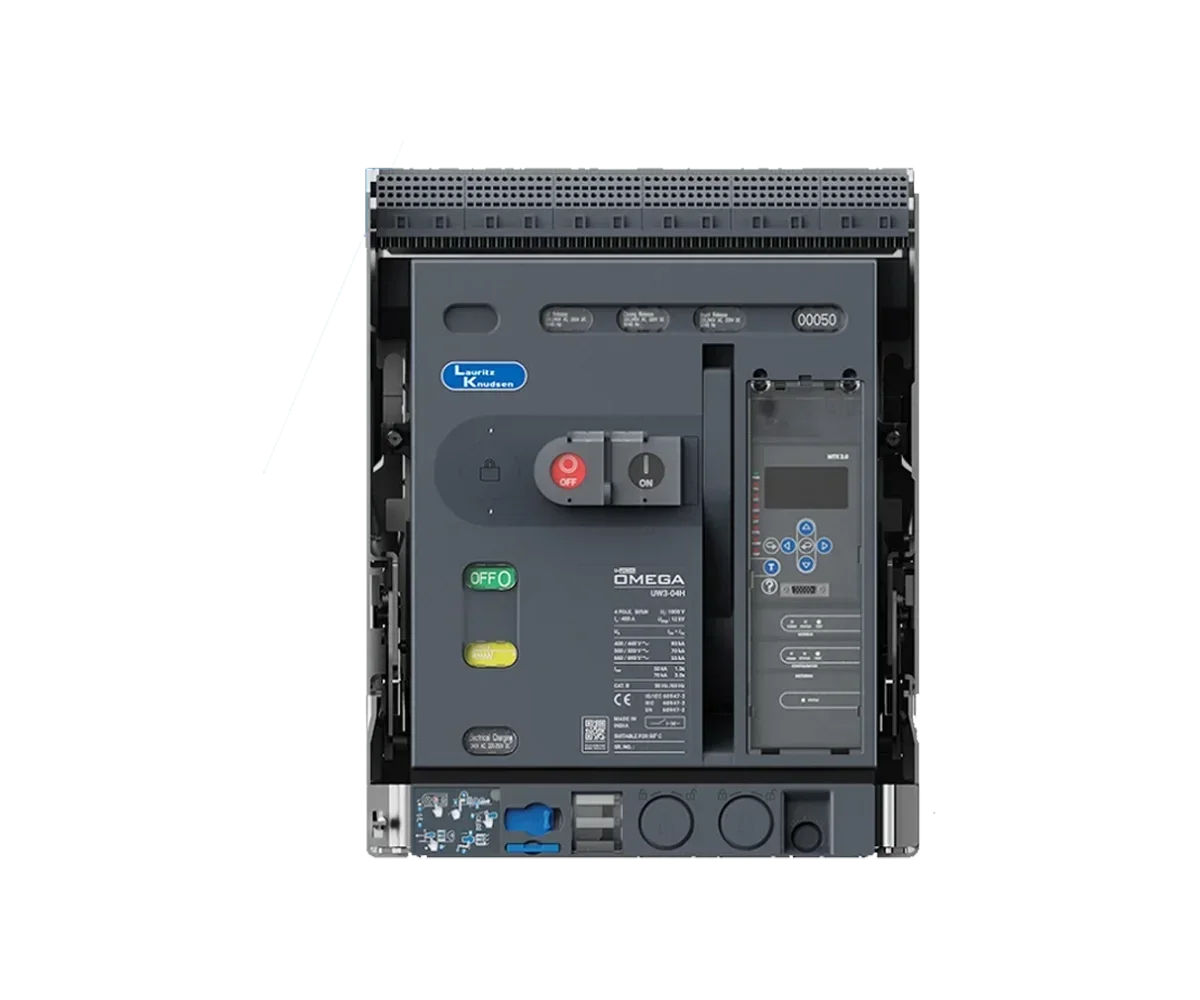
An Air Circuit Breaker sits at the top of the protection hierarchy in most industrial and commercial buildings. It guards the main incoming supply before it splits into smaller distribution paths. Its primary role is high-current main incoming protection, typically where a facility draws power directly from a transformer or utility feed.
ACBs are built for current ranges from 630A up to 6300A and beyond. They use air as the arc-extinguishing medium, supported by arc chutes and magnetic arc control mechanisms to safely extinguish the arc during interruption. Most units carry adjustable trip settings. Many also use a fully drawn-out design, letting maintenance teams withdraw the breaker for servicing without disturbing the busbar. In any ACB vs MCCB vs MCB discussion, the ACB is almost always positioned first in line.
One step down the distribution chain sits the Molded Case Circuit Breaker. Its role is heavy-duty feeder protection for sub-distribution systems and motor loads. MCCBs cover 16A to 1600A, giving them far more versatility in placement than an ACB. Most rely on thermal-magnetic or electronic trip units. Depending on the model, trip settings can be fixed or adjustable to suit the downstream load.
In an MCCB vs ACB comparison, size alone tells the story: MCCBs are compact enough for floor-level distribution boards, while ACBs stay confined to main switchrooms. This makes the MCCB the workhorse breaker of mid-tier panels, and it is usually the answer when the question is MCB vs MCCB for anything beyond a small final circuit.
An RCCB serves a completely different purpose from the breakers above it. Its primary role is dedicated to earth leakage and shock protection, aimed at human safety rather than equipment. RCCBs are commonly available in current ratings from 16A to 125A, while residual current sensitivities may include 10mA, 30mA, 100mA, and 300mA depending on the application.
Here is something that surprises many people: an RCCB provides zero overload or short-circuit protection. It simply monitors the balance between incoming and outgoing current. If even a small amount leaks to earth, say through damaged insulation or a person touching a live part, it disconnects the supply almost instantly. This is exactly why the MCB vs RCCB question, as well as the broader MCB vs RCCB vs RCBO question, come up so often in residential wiring discussions.
An RCBO combines overcurrent protection and residual-current protection in a single device. It protects an individual circuit against overloads, short circuits, and earth leakage, depending on its specific design and ratings. One unit now guards against overloads, short circuits, and earth leakage at the same time. There is no need for two separate breakers wired together. RCBOs are typically available in ratings similar to MCBs, with ratings commonly extending up to 63A for final circuits, although higher-rated variants are available for specific applications.
When comparing RCCB vs RCBO, the real difference is scope. An RCCB protects a group of circuits from leakage only. An RCBO protects one circuit from everything. ACB vs RCBO barely counts as a comparison at all, since the two sit at opposite ends of the distribution chain: one guards a building's entire incoming supply, the other guards a single outlet.
Placed side by side, the technical gaps between these five breakers become clear quickly. Current rating, interrupting capacity, and installation point all shift as you move from the main incomer down to the final circuit. Cost tends to follow the same curve.
There is no single answer to how to choose the right circuit breaker. It depends on where the protection sits and which fault is most likely there. Building type, load profile, and safety requirements all determine the final decision.
A typical home or small office follows a simple chain. The utility meter typically feeds a main isolator or an appropriately rated MCCB/MCB, followed by protective devices such as RCCBs, RCBOs, and MCBs for individual circuits. The exact arrangement depends on the installation design and applicable electrical requirements. This layout keeps overcurrent protection centralized at the main board while pushing earth leakage protection down to the point of use. It is practical and cost-effective. A single faulty appliance trips only its own circuit, not the whole home.
Larger commercial buildings need a taller hierarchy. A main incomer ACB handles the bulk supply entering the building, feeding down into floor-level distribution MCCBs that manage tenant loads or floor sections. Branch circuits then use RCBOs or RCCBs, depending on whether overcurrent protection is already covered upstream. The tiered structure supports selective coordination across multiple floors, which matters greatly in office towers, hotels, and mixed-use developments, where one floor's outage should never touch another.
Industrial environments demand higher interrupting capacities, since fault currents run larger near heavy machinery and transformers. Motor protection MCCBs are common here, often paired with adjustable delayed trip settings for coordination between the main breaker and downstream feeders. Facilities running large motors cannot afford sudden shutdowns. Breakers are deliberately time-graded, isolating faults at the smallest possible level before they reach anything upstream.
Also Read: What is the Difference Between Relay and Contactor
Circuit breaker selection comes down to one principle: match the device to its job. Use MCBs for everyday final circuits, ACBs for high-current main incomers, MCCBs for feeders and motor loads, RCCBs for dedicated earth leakage protection, and RCBOs where a single circuit needs complete protection in one unit. Getting this layering right protects both equipment and people, while building a system which fails safely rather than catastrophically. A full range of MCBs, ACBs, MCCBs, RCCBs, and RCBOs is available from established manufacturers like Lauritz Knudsen Electrical & Automation, engineered to meet these layered protection requirements across residential, commercial, and industrial installations.
No. An RCCB only detects earth leakage. It should always be paired with an upstream MCB or MCCB or used alongside proper overcurrent protection for short circuits and overloads.
Most manufacturers recommend testing RCCBs and RCBOs every six months using the built-in test button. ACBs and MCCBs in industrial areas frequently follow annual maintenance schedules tied to load conditions.
Not necessarily. Oversizing a breaker beyond what a circuit needs can delay tripping during a genuine fault. That raises risk instead of lowering it.
Rarely. ACBs are built for high-current main incomers typical of industrial and large commercial buildings. Their size and cost make them unfeasible for standard homes.
Repeated tripping usually points to a genuine earth leakage issue, such as damaged wiring or a faulty appliance. A qualified electrician should investigate rather than resetting it repeatedly.
Choose an RCBO when individual circuit protection is required. An RCBO protects against overloads, short circuits, and earth leakage on a single circuit, while an RCCB provides earth leakage protection and relies on separate overcurrent protection devices.

Sourav Dasmodak,
Product Management & Marketing (Powergear - ACB)Product Owner of Air Circuit Breaker (ACB) of Lauritz Knudsen for Domestic & International Market. I can talk to you about Electrical Products' Sales, Business Development, Market Expansion, Cracking Critical Strategic Account, handling Key Account & of course how to develop & motivate Channels along with the organizational growth. Having near about one and a half decade of experience across the country with major electrical manufacturers (Top 4).
Assistance Required?
Select an option to Contact Us

 Contact Us

